
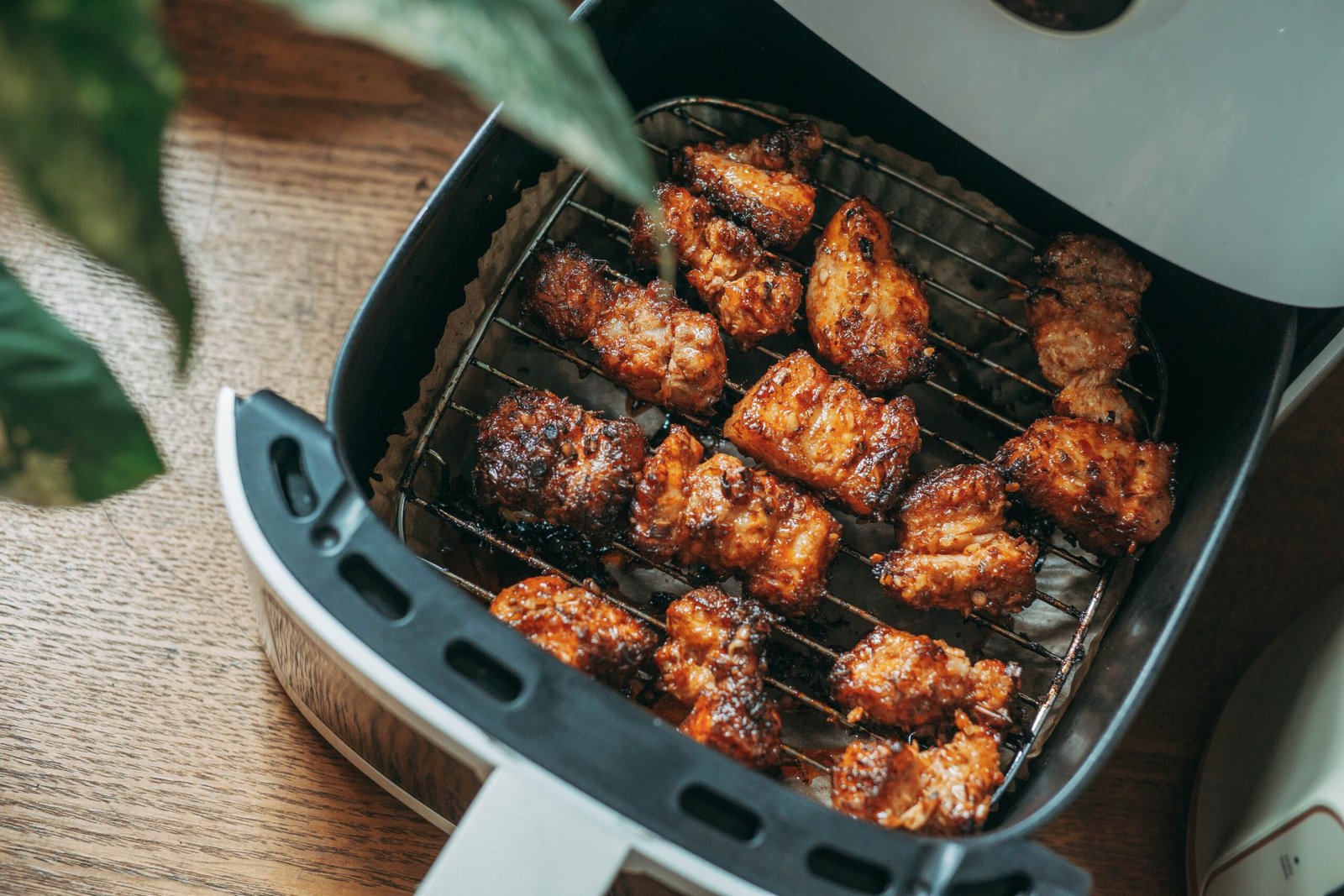
Air fryers have gone from novelty to countertop staple in a few years, and most of the marketing rests on one idea: crispy food, minus the guilt. It’s a nice promise, but it raises an obvious question. If you already own an oven, is the air fryer actually healthier, or is it a very good-looking small oven?
The honest answer is more interesting than “yes” or “no.” The air fryer has a real health advantage over deep frying, and that’s the comparison its reputation was built on. Against a regular oven, the gap is much smaller, and in a few respects the oven comes out ahead. What ends up on your plate depends far more on the food, the oil, and how brown you let it get than on which appliance you choose.
This guide compares the two on the things that matter: fat and calories, nutrients, browning byproducts like acrylamide, meat and fish, materials and coatings, energy, and practicality, then ends with a simple way to decide.
The Short Answer
An air fryer is essentially a compact, high-powered convection oven. Both cook with hot, moving air, so the nutritional difference between air-fried and oven-roasted food is usually small. The air fryer’s real health benefit shows up when it replaces deep frying or heavy pan frying, because you can get a crisp result with a tablespoon of oil or less instead of submerging food in it.
Where it gets nuanced:
- Fat and calories: An air fryer clearly beats deep frying. Against oven roasting, the difference depends mainly on how much oil you use, which is up to you.
- Acrylamide: Both can form it in starchy foods. Studies conflict on which is lower, and one home-cooking study found oven-fried potatoes had less than air-fried. Cooking time and color matter more than the machine.
- Nonstick coatings: Many air fryer baskets are nonstick, which raises questions an uncoated oven tray doesn’t. Ceramic and stainless options exist.
- Practical factors: The air fryer is faster and efficient for small batches. The oven handles large batches and more cooking styles.
In other words, choose the one that makes you cook more vegetables, less deep-fried food, and less charred food. Either can do that.
First, What Is an Air Fryer?
An air fryer is a small countertop appliance with a heating element and a powerful fan. It circulates very hot air around food in a compact chamber, usually a basket. That’s the same principle as a convection (fan) oven, only smaller and more intense. As one source puts it, an air fryer is like a small convection oven that circulates hot air in a chamber around the food. cathe
The compact chamber and strong airflow are why air fryers crisp food quickly and why they preheat fast. They don’t actually “fry” in the traditional sense. They roast and bake very efficiently, with a bit of oil if you add it.
That’s the key to understanding the comparison. If you already use a fan-forced oven on a high setting with a perforated tray, you’re doing something very similar, just in a bigger box.
Fat and Calories: Where the Air Fryer Shines
The headline advantage is easy to see when you compare it to deep frying. The main health benefit of air-fried meals is lower fat compared to pan frying or deep frying, since you’re brushing or drizzling food with a touch of oil rather than submerging it. A deep fryer can add hundreds of calories to a serving through oil absorption. Air fryers often need around a tablespoon of oil or less, and sometimes none. weight watchers
That matters most for foods you’d otherwise fry: french fries, breaded chicken, fish and chips, and egg rolls. If swapping the deep fryer for an air fryer is what you’re considering, the fat and calorie savings are genuine.
Against the oven, the picture is more even. You can roast vegetables or cook frozen fries in an oven with the same small amount of oil, and the calories will be similar. As one source notes, because the air fryer and oven use similar heating techniques, your food will generally have the same nutrient profile with both. The air fryer just makes it easier to get a crisp finish without extra oil, since the compact chamber and airflow do the work that extra fat otherwise might. evolvingtable
So the fair framing is that the air fryer lowers the bar for crispiness with little oil. If you’d otherwise add a lot of oil to the oven tray to get crunch, you’ll save some. If you already use a light hand, you won’t save much.
Nutrients: Mostly a Tie
Both methods use dry heat, and both can reduce heat-sensitive vitamins, particularly vitamin C and some B vitamins, though less than boiling in water, which you then discard. Shorter cooking times in the air fryer may help a little in some cases, but there’s no strong evidence that one consistently preserves more nutrients than the other. For most foods, treat this as a tie and look at the bigger factors: what you’re cooking and how much oil, salt, and breading you add.
One exception worth flagging is fatty fish. One study reported that air frying sardine fillets increased oxidized cholesterol and reduced the amount of polyunsaturated fats, including omega-3s. That’s a single study on one type of fish, so I wouldn’t read too much into it, but it’s a reminder that very high, dry heat isn’t always kind to delicate fats. For salmon and sardines, gentler methods like baking at a moderate temperature, poaching, or steaming are reasonable choices if preserving omega-3s is a priority. cathe
Acrylamide: Less Clear Than the Marketing Suggests
Acrylamide is a chemical that forms in starchy foods when they’re cooked at high temperatures, especially above roughly 120°C (248°F). It’s created when natural sugars and an amino acid called asparagine react, the same browning reaction that gives crisp fries and toast their flavor. In laboratory studies, acrylamide caused cancer in animals, but at levels much higher than those found in food, and the FDA is researching whether the lower levels in food pose a risk to people. Evidence in humans isn’t clear or consistent, but regulators advise sensible steps to keep intake down. FDA
Air fryer vs. deep fryer
Many sources report that air frying produces less acrylamide than deep frying. One health resource notes that one study found 90% lower acrylamide in air-fried food versus deep-fried, while other research shows no significant differences between air frying, deep frying, and oven frying. So the picture is mixed, and the exact reductions you’ll see quoted vary a lot by food and test conditions. weight watchers
Air fryer vs oven
Here, the evidence doesn’t favor the air fryer. A 2023 study in Frontiers in Nutrition cooked home-style potatoes with three methods. Air-fried potatoes had the highest acrylamide (about 12.19 µg/kg), followed by deep-fried (8.94 µg/kg) and oven-fried (7.43 µg/kg). The authors noted that oven-frying was lower than air frying and that the role of air fryers in acrylamide formation should be further investigated. The variation within each group was large, so this isn’t a verdict, just a sign that “air fryer means less acrylamide” isn’t a safe assumption. frontiersinfrontiersin
What actually matters
The consistent message from regulators is about time, temperature, and color, not the appliance. More acrylamide accumulates when cooking is done for longer or at higher temperatures, and cooking cut potato products to a golden yellow color rather than brown helps, since brown areas tend to contain more acrylamide. The FDA also suggests soaking raw potato slices in water for 15 to 30 minutes before frying or roasting, then draining and blotting them dry. And the agency advises against refrigerating raw potatoes, which can raise acrylamide when cooked. fdafda
Air fryers’ fast, intense heat can brown the outside of potatoes quickly, so it’s easy to overshoot into dark brown. Watch the color of whichever appliance you use. For perspective, regulators also stress that this is one small piece of overall diet. As one food chemist put it, the shade of your toast matters less than what you put on it.
Meat and Fish: Charring Is the Issue
High-temperature cooking of meat can form compounds called heterocyclic amines (HCAs) and polycyclic aromatic hydrocarbons (PAHs), especially with charring, flare-ups, and smoke from dripping fat. The UK Food Standards Agency notes that cooking meat at high temperatures such as grilling or barbecuing can produce cancer-causing chemicals called HCAs and PCAs. Gulf News
An air fryer’s enclosed chamber and lack of open flame mean less smoke contact than grilling. But very hot, dry cooking can still brown and char meat surfaces. I couldn’t find strong comparative data for air fryers versus ovens on HCAs, so I’d treat this as unsettled. The practical guidance is the same either way: avoid blackened, burnt bits, don’t overcook, and use a thermometer so you cook meat safely without overshooting. Cooking poultry and ground meat to a safe internal temperature matters for food safety regardless of method.
Nonstick Coatings and Materials
Here the oven usually has an edge, simply because a stainless steel or glass tray has no coating to worry about.
Many air fryer baskets and trays are nonstick. Some nonstick coatings historically used PFAS (“forever chemicals”), and concerns have been raised about whether they could affect food, especially if scratched or overheated. It’s worth keeping the evidence in proportion. One consumer-safety review found that many popular cookware and air fryer brands don’t use PFAS in their manufacturing, and the expert quoted said reputable brands often use ceramic nonstick coatings, advising against metal utensils that scratch the surface. Another summary notes that the claim that air fryers cause cancer is not supported by evidence from normal use, though PFAS-coated surfaces can degrade if heated extremely or damaged. tomsguide
If you want to avoid the question:
- Look for ceramic or stainless steel baskets, and check manufacturer information on PFAS rather than relying on vague “non-toxic” claims.
- Use parchment liners made for air fryers or a silicone insert. Baking paper or a silicone basket can be used as alternatives. wellnesspulse
- Avoid metal utensils that scratch coatings, and replace baskets with flaking or peeling surfaces.
- Follow the first-use instructions. New units can give off an odor or irritating vapors during initial use, so run them empty and ventilate as directed.
- Don’t overload the basket or block vents, which helps both cooking and safety.
An oven tray made from uncoated metal sidesteps all this, which is a quiet advantage for anyone who wants the simplest setup.
Energy and Convenience
This is where the air fryer often earns its place, though the story isn’t one-sided.
Air fryers typically use around 800 to 1,800 watts and heat up quickly with little preheating. For a small meal or snack, that usually means less time and less energy than heating a full-size oven. Air fryers use between 800 and 1,800 watts, making them more energy-efficient than most ovens when cooking small meals or snacks. (That line comes from a manufacturer, so take the claim as a reasonable generalization rather than a measured result.) greenpan
But capacity cuts the other way. If you’re cooking for four or five people, you may need several air fryer batches, which can eat up the time and energy savings, while an oven cooks it all at once. And if you already own an oven, buying and storing an extra appliance has its own costs.
A Quick Comparison
| Air fryer | Oven | |
|---|---|---|
| Fat and calories | Crisps with little or no oil | Same, if you use similar oil |
| Versus deep frying | Much less oil | Much less oil |
| Nutrients | Similar dry-heat results | Similar |
| Acrylamide | Unclear; depends on time and color | Unclear; one study lower than air fryer |
| Nonstick concerns | Common coatings; ceramic and stainless exist | Typically uncoated trays |
| Speed and energy | Fast, efficient for small batches | Slower, better for large batches |
| Capacity | Small | Large |
| Versatility | Reheating, crisping, small roasts | Baking, roasting, broiling, big meals |
What to Cook Where
Rather than picking a winner, think about which tool suits which job.
Air fryer works well for:
- Frozen fries, nuggets, and breaded items you’d otherwise deep fry or oven-bake with extra oil
- Crisping roasted chickpeas, cauliflower, broccoli, and Brussels sprouts with a teaspoon of oil
- Reheating pizza, fries, and leftovers, which come back crisp instead of soggy
- Small portions of chicken thighs, wings, and cutlets
Oven works well for:
- Sheet-pan meals and anything for a crowd
- Baking, casseroles, and big roasts
- Fatty fish and delicate dishes where gentler, moderate heat is better
- Cooking without any nonstick surface involved
Either can work for: roasted vegetables, potatoes (watch the color), and chicken pieces.
Getting the Most Health Benefit From Either
The appliance sets the stage, but these habits do most of the work:
- Use less oil, but not none. A teaspoon or two of a high-heat oil like avocado or refined olive oil helps with browning and texture and adds healthy fat.
- Cook to golden, not dark brown, especially for potatoes, bread, and root vegetables.
- Soak cut potatoes for 15 to 30 minutes, then dry them thoroughly before cooking.
- Don’t overcrowd. Air needs to circulate, and crowded food steams rather than crisps.
- Skip heavy breading and sugary sauces where you can, since sugar burns quickly in high heat.
- Fill the plate with vegetables. Roasting or air frying makes vegetables more appealing, which is probably the biggest health win of all.
- Remember the bigger picture. An air-fried processed food is still a processed food. Fries from a bag are not a health food just because they skipped the deep fryer.
The Takeaway
The air fryer is healthier than a deep fryer, and that’s where the claim holds up best. Against your oven, it’s a much closer contest: similar cooking science, similar nutrients, and differences that come down to oil, color, and the materials in the appliance. The air fryer wins on speed and small-batch efficiency, the oven on capacity and, for some people, simplicity of materials.
If an air fryer makes you more likely to cook vegetables, leaving the deep fryer behind and relying less on takeout, it’s a healthy addition. If you already roast well in your oven, there’s no strong health reason to switch. Pick the tool you’ll actually use, watch the browning, and keep the rest of your plate balanced. This article is general information, not medical advice.